
Moldova population trends 2016–2026
The country is losing people every year
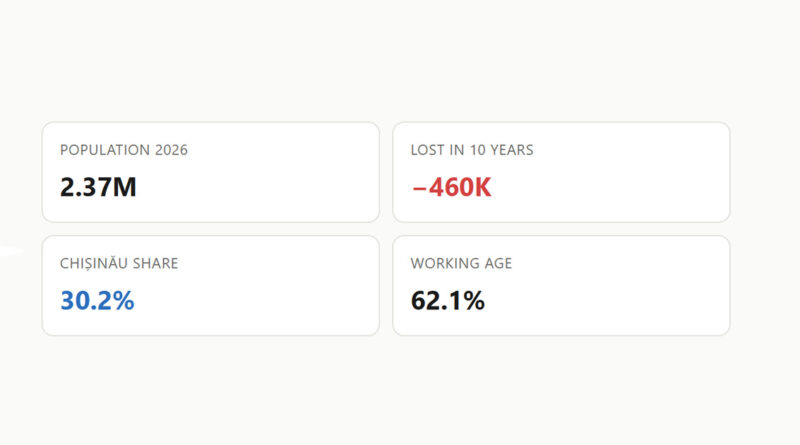
Between 2016 and 2026, Moldova lost about 460,000 people — a drop of 16.3%. The population fell from 2.83 million to 2.37 million. That is roughly 46,000 people per year, or a mid-sized town disappearing annually.
The sharpest drops came in 2022–2024 (up to −3.1% per year). This is partly because the 2024 census showed the real numbers: many people had already left the country, but the old estimates from the 2014 census did not count them. In 2025–2026, the decline slowed to about 1% per year.
Chișinău is absorbing the country
Chișinău is the only place in Moldova that actually grew — by 46,000 people (+6.9%). Meanwhile, every other part of the country shrank. The capital’s share jumped from 23.7% in 2016 to 30.2% in 2026. Nearly one in three Moldovans now lives in Chișinău.
The urban-rural balance is also shifting: the urban share rose from 39.7% to 47.1%. But this is less about cities growing and more about villages emptying faster.
In 2016, about 1 in 4 Moldovans (23.7%) lived in Chișinău. By 2026, the number is closer to 1 in 3 (30.2%) — a gain of 6.5 percentage points in a single decade. The capital did not just hold its ground while the rest declined; it actually added people, growing from 668,000 to 714,000. This concentration mirrors a pattern common in small post-Soviet states where the capital becomes the dominant economic magnet.
The population is getting older
Working-age people (15–64) made up 69.9% of the population in 2016. By 2026, that fell to 62.1%. At the same time, the share of people aged 65 and over grew from 12.0% to 18.6%.
The most dramatic collapse is among young adults. The 20–24 age group shrank by half (−50%), and the 25–29 group lost nearly 60%. These are the people who left for work abroad. The 65–69 and 70–74 groups, on the other hand, grew by 30% and 77% respectively.
The dependency ratio — how many children and retirees each 100 working-age people must support — jumped from 43 to 61. This puts growing pressure on pensions, healthcare, and the economy.
Which districts lost the most?
Every single district in Moldova lost population — no exceptions. The worst losses are in the northern and southern periphery: Ocnița (−31.4%), Briceni (−29.7%), Leova (−29.6%), Glodeni (−29.5%).
The districts with the smallest decline are either suburbs of Chișinău — like Ialoveni (−11.4%) — or Bălți (−9.5%), the country’s second-largest city and the main urban center in northern Moldova, which acts as a regional hub attracting people from nearby districts.
Data covers usual resident population, excluding Transnistria and Bender.
2016–2023 estimates are based on the 2014 census; 2024–2026 are based on the 2024 census. The 2026 figure is preliminary.